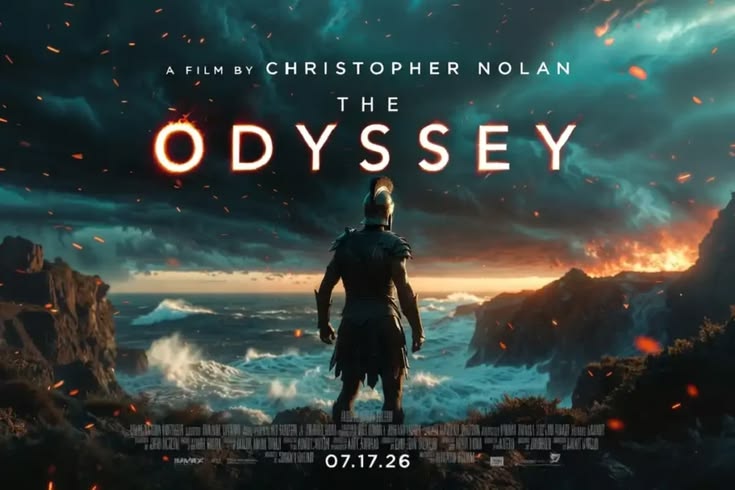
Christopher Nolan has returned with a massive cinematic adaptation of the ancient Greek epic. Pushing past the internet noise, Nolan delivers a breathtaking film that relies heavily on massive practical effects, plunging the audience into a gritty, CGI-free mythological world.
The Interlocking Narrative: Three Timelines That Collide
Like many of Nolan’s signature works, the film ditches straightforward chronological storytelling in favor of three parallel timelines that brilliantly converge:
- War and Guilt: We see Odysseus’s tactical brilliance in ending the Trojan War, but it comes at a heavy cost. He intentionally sacrifices “Sinon” to make the Trojan Horse deception work. The film strips away the romanticism of the legendary horse, presenting it instead as a claustrophobic trap filled with human suffering and moral decay.
- The Island of Oblivion: On Calypso’s remote island, we find Odysseus (Matt Damon) stripped of his identity and memories. He is numbed by lotus flowers, allowing him to escape the trauma of his past and the heavy responsibilities of leadership.
- The Stolen Homeland (Ithaca): Back home, Penelope and her son Telemachus are trapped in their own palace, besieged by greedy suitors. Robert Pattinson’s character, Antinous, serves as the main villain—delivering a chilling performance as a cruel, manipulative, and insanely entitled antagonist. If you are wondering who is Antinous in The Odyssey, the film portrays him as the ultimate embodiment of toxic entitlement within Odysseus’s absence. Similarly, for those asking who is Telemachus in The Odyssey, the film brilliantly captures his coming-of-age journey as he grows up under the shadow of a legendary father.
Iconic Mythological Encounters: The Cyclops and Circe
Nolan treats Greek mythology not as a typical fantasy, but as epic-scale psychological horror. The gods and monsters are depicted as terrifying, unstoppable forces of nature.
- The Cyclops in The Odyssey: One of the most haunting sequences involves the terrifying encounter with the Cyclops. Trapped inside a cave blocked by a massive boulder, Odysseus and his men face a relentless nightmare.
- Who’s playing Circe in The Odyssey? The mesmerizing and haunting witch Circe is brilliantly brought to life by Samantha Morton. When Odysseus’s exhausted men consume her food, Circe physically transforms them into pigs, serving as a dark commentary on the gluttony and unbridled appetites of conquerors.
Is Travis Scott in The Odyssey Movie?
One of the most talked-يا عنه internet queries is: is Travis Scott in The Odyssey? or is Travis Scott in The Odyssey movie? Yes, the famous rapper makes a surprising and unique cameo appearance in the film. Following their successful collaboration on Tenet, Travis Scott secured a special appearance in Nolan’s latest epic, adding an unexpected modern touch to the ancient setting.
The Epic Ending Explained: How Does The Odyssey End?
Many viewers looking up how does the Odyssey end will find that Nolan stays true to the emotional core of the myth while elevating the climax. The film reaches its boiling point when Odysseus returns to Ithaca in disguise and successfully strings his legendary bow. What follows is a brutal, cathartic massacre of the suitors by Odysseus and his son.
However, the true genius lies in the aftermath. Instead of simply reclaiming his throne and pretending nothing has changed, Odysseus and Penelope accept a harsh reality: 20 years of war, trauma, and waiting have altered them forever. In a beautiful twist, they choose to leave the throne behind and sail away together, finally free from their burdens. Telemachus remains in Ithaca, stepping up to take his rightful place as the new king.
Final Verdict: Is It Worth the Hype?
While some of Nolan’s dialogue can feel a bit heavy at times, the movie is an absolute visual triumph. Seeing this on the big screen is mandatory to truly experience the terrifying grandeur of the world. Because of the non-linear storytelling, The Odyssey is a film that will undoubtedly get even better on a second watch.
About the Author